The whole visit, in order, including the parts where we say no
What Happens on an IV Visit in Broomfield
In short
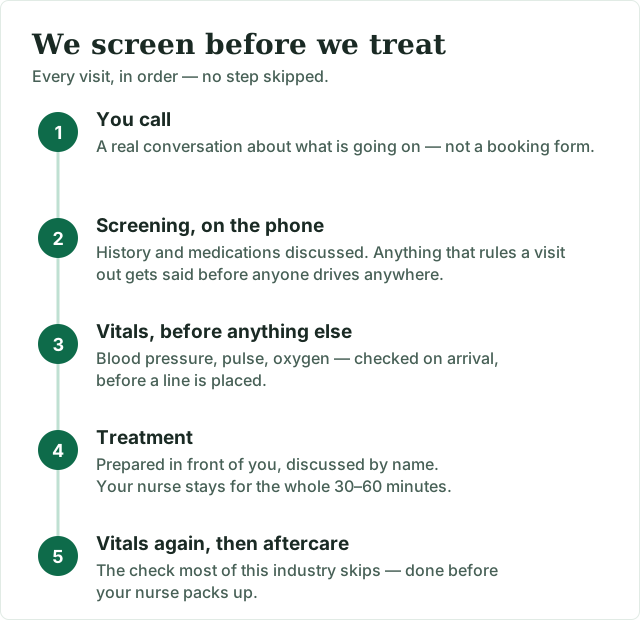
An IV visit in Broomfield starts with screening, not a needle. On the phone you talk through symptoms, conditions and medications. At your door, an ICU- or ER-trained critical-care registered nurse confirms your history and measures blood pressure, pulse and oxygen before any line is placed. The nurse then treats as discussed, adjusts the plan, or refers you to a higher level of care, and you are not charged for treatment you did not receive. Treatment takes 30 to 60 minutes for most people, with the nurse present throughout, and vitals are measured again before they leave. This page is for anyone judging the service before spending money on it. It covers the screening, who arrives and who oversees them, where the products come from, what we decline, and what a mobile IV service does not carry.
This page walks through an Intravene visit in Broomfield from phone call to door close. It exists so you can judge the service before you spend money on it — and so the parts most providers leave vague are in writing here instead.
The screening, first and in full
Nothing is hung until a clinician has decided it should be.
On the phone
You talk through what is happening — symptoms, how long, what you have kept down, existing conditions, medications. Some bookings end here, on purpose: if what you describe already sounds like an emergency department problem, we say that instead of taking your money first.
At your door
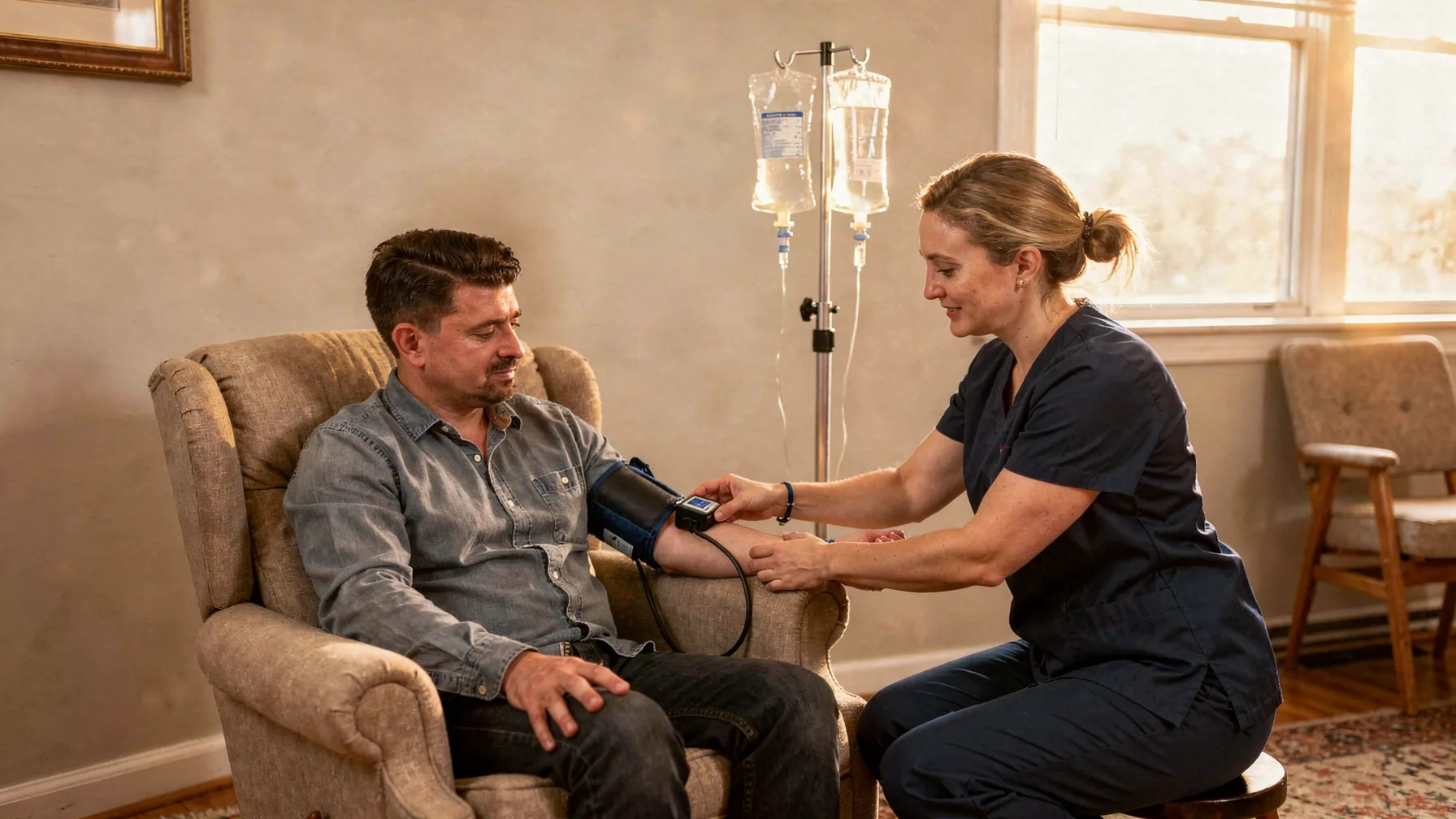
Your nurse repeats the assessment properly: history confirmed, then vital signs — blood pressure, pulse, oxygen saturation — measured before any line is placed.
The decision
Treat as discussed, adjust what was planned, or refer you to a higher level of care. All three happen. The third one costs us a booking and is still the correct outcome — a service that can only ever conclude "yes, you need what we sell" is not doing an assessment, it is doing a sales script.
Not sure IV therapy is right for you? You are screened on the phone before anything is booked.
Who arrives, and who oversees
Your nurse
An ICU- or ER-trained critical-care registered nurse, every visit. Their day job is starting and managing IV lines on genuinely sick people, and their training is in spotting deterioration early. You will be told the name of your nurse before the visit. Colorado nursing licences are public record through the Division of Professions and Occupations, and we would rather you looked ours up than took this page's word for it.
Medical oversight
Intravene operates under independent medical oversight from Guardian Medical Direction, a national physician-led medical direction group. Guardian provides medical oversight to medical spas, wellness centers, telemedicine companies, and healthcare practitioners across the country. Through its team of highly qualified medical directors and physician collaborators, Guardian's mission is to provide high-quality medical oversight to practitioners striving to increase access to healthcare and better the lives of their clients and patients. Stated precisely: Guardian's oversight governs how care is delivered. It is not a review or endorsement of this website's content. We keep those two things separate.
What is in the bag, and where it comes from
Everything used on a visit is a commercially manufactured pharmaceutical product, prepared on site after the assessment — not a pre-mixed bag chosen before anyone spoke to you, and not a compounded preparation. We do not use compounding pharmacies, and there is no proprietary blend whose contents are a secret.
That word — compounded — is worth knowing. Compounded sterile products are made outside a manufacturer's quality system, and they are where regulators have found this industry's worst problems. Whether a provider's ingredients are manufactured or compounded is one of the most useful questions you can ask, of anyone, including us.
Supplies are single-use and opened in front of you. What goes in your drip is named before it goes up; the packaging is in the bag if you want to see it.
Not sure IV therapy is right for you? You are screened on the phone before anything is booked.
The visit itself
During the visit
Thirty to sixty minutes for most treatments. Your nurse stays for all of it — the line is never set and left. You sit where you like; most people pick the sofa.
Before your nurse leaves
Vitals are measured a second time, after treatment. Most of this industry describes "monitoring" and means the middle of the session. The closing check is the one that tells you whether the treatment worked and catches the small number of problems that arrive late. It is standard practice in every clinical setting these nurses trained in, so it is standard practice here.
The honest limits
What we decline
Some bookings we turn down, and the list should not be a surprise by this point on the page: the red-flag symptoms — fainting, confusion, chest pain, trouble breathing, blood where it should not be, severe abdominal pain, a stiff neck with fever, many hours without urine — belong in an emergency department, and we say so. Pregnancy, advanced age, immunosuppression, and significant heart or kidney disease do not automatically rule a visit out, but they change the assessment, and sometimes the outcome is that you should be somewhere with more equipment than a nurse's kit.
What we do not carry
We are a mobile IV service. That sentence has honest limits, and here they are: no supplemental oxygen, no laboratory testing, no imaging, no diagnosis — and nothing close to what an ambulance carries. We treat dehydration where dehydration is the problem. When the problem is something else, the visit's job is to tell you that and point you right.
Frequently asked questions
What gets checked before treatment?
Your history and medications, then measured vital signs — blood pressure, pulse, oxygen — before a line is placed. The treatment decision comes after the assessment, not before.
Can the nurse decide not to treat me?
Yes, and occasionally that is exactly what happens. You are told why, told where to go instead, and not charged for treatment you did not receive.
Who does the visit?
An ICU- or ER-trained critical-care registered nurse. You get the name in advance, and Colorado licences are publicly verifiable.
How long does it take?
Assessment plus 30–60 minutes of treatment, plus the closing vitals check.
Is any of this covered by insurance?
No. It is an elective service, paid directly.
If that is the kind of visit you want
Book mobile IV therapy in Broomfield by phone. The screening happens in the call, and again at your door before anything is placed. Or call (303) 872-4027.